I Read the Anthropic Legal Prompts That Crashed $285B in Stocks
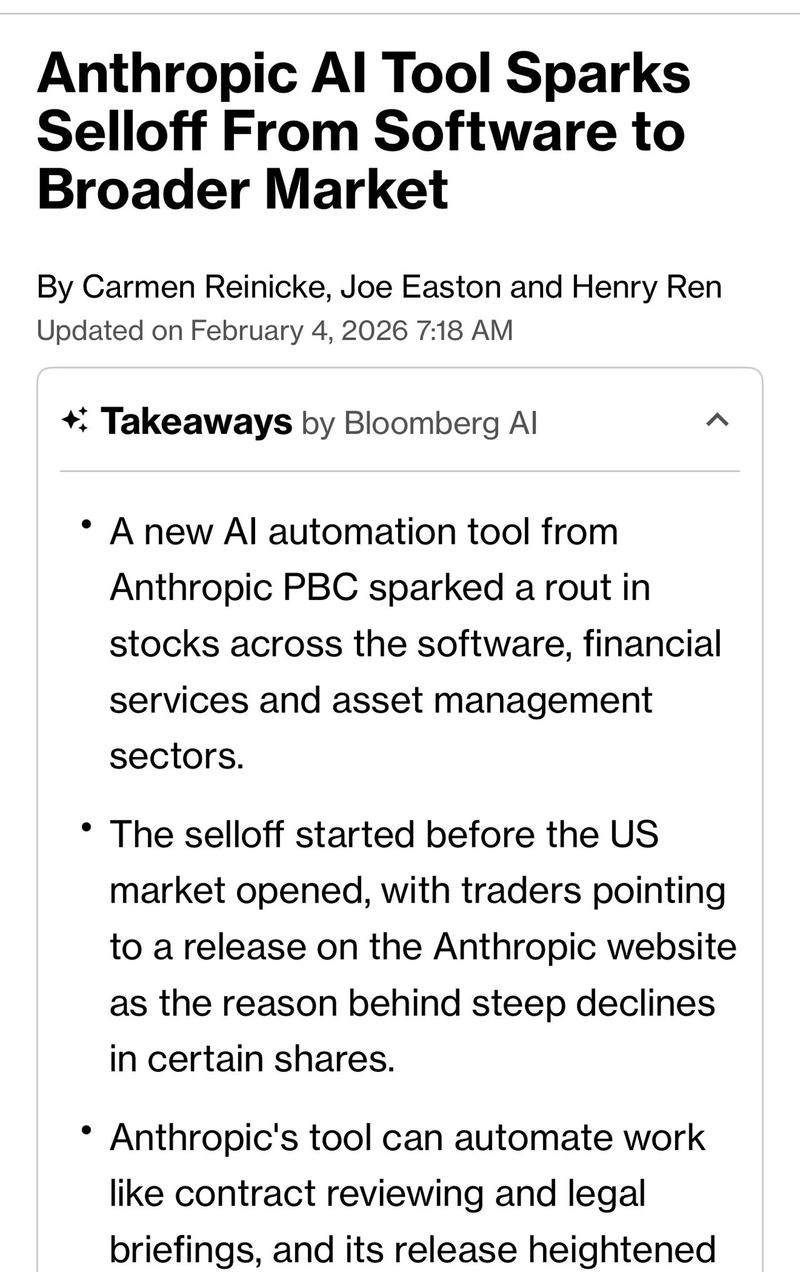
On February 3, 2026, tech stocks went into free fall. Thomson Reuters dropped 15.83% — its biggest single-day decline on record. LegalZoom fell 19.68%. The Goldman Sachs US software basket lost 6%. Total damage: $285 billion in market cap, gone in a single session.
Bloomberg ran the headline: “Anthropic AI Tool Sparks Selloff From Software to Broader Market.”
So I went and read what Anthropic actually shipped.
What Anthropic Actually Released
On January 30, Anthropic open-sourced
eleven plugins for
Claude Cowork, their agentic desktop app. One of those plugins was for
legal work —
six subdirectories of plain text files: contract-review, nda-triage,
compliance, legal-risk-assessment, meeting-briefing, and
canned-responses.
No new model. No API. No product launch. A GitHub repo with ~2,500 lines of structured prompt instructions. The kind of thing thousands of developers write every day when building on top of LLMs.
Here’s the core of the contract review methodology, quoted directly from the repo:
- Identify the contract type: SaaS agreement, professional services, license, partnership, procurement, etc.
- Determine the user’s side: Vendor, customer, licensor, licensee, partner.
- Read the entire contract before flagging issues. Clauses interact with each other.
- Analyze each material clause against the playbook position.
- Consider the contract holistically: Are the overall risk allocation and commercial terms balanced?
That’s the review process. The entire methodology. Identify, determine sides, read, analyze, consider holistically. This is what a law school student probably learns on day one.
First-Year Law School Material
The NDA triage skill is a 10-point checklist: agreement structure, definition scope, obligations, standard carveouts, permitted disclosures, term, return/destruction, remedies, problematic provisions, governing law. Every in-house legal team has this document pinned somewhere. The green/yellow/red classification system is a standard risk matrix — the same framework taught in corporate legal training.
Don’t get me wrong: The prompts are well-crafted. But: They’re not magic. They’re structured instructions for tasks that legal professionals have been doing for decades. And they’re open source — anyone can read them, copy them, modify them. You can run them in OpenAI. Or an Open Source Model like DeepSeek.
There is no competitive advantage here that couldn’t be replicated by a competent developer in an afternoon.
The Information Asymmetry Is the Story
The repo is public. Anyone could have read it in 10 minutes. The market priced in fear of something that’s fully auditable on GitHub. That gap between perception and reality is the actual story.
So $285 bn lost — not because of a product launch, but because of a markdown file in a GitHub repo. Investors didn’t click through. They didn’t read the prompts. They didn’t ask a single engineer what a “skill plugin” actually is. They saw “Anthropic” and “legal” in the same sentence and hit sell.
This isn’t an AI disruption story. This is a market literacy story. The selloff tells us nothing about AI’s impact on the legal profession and everything about how poorly the market understands what AI companies actually ship.
What This Actually Tells Builders
Anthropic published these prompts freely because the prompts aren’t the product.
The “moat” for vertical AI isn’t prompt engineering — it’s execution, trust, integration, compliance, and liability acceptance. Anthropic just demonstrated that by giving the prompts away. What does that tell you about every “AI wrapper” startup whose entire value prop is a system prompt?
The Real Question
AI will reshape law firms, consultancies, and half the NASDAQ. That’s not controversial. The “software eating software” thesis has been in every VC deck since 2023. Claude Code, Cursor, Codex — they all exist. Nobody disputes the direction.
So why did a GitHub commit containing first-year law school content trigger a $285 billion repricing? Either the market hadn’t priced in something that’s been “obvious to everyone” — meaning it wasn’t actually obvious to investment professionals — or they overreacted to a headline without reading the repo. Both are equally frightening.
And here’s the kicker: this repo is public. If the people managing your money can’t do due diligence on something freely auditable on GitHub, what are they diligencing behind closed doors?
If your investment thesis can be wrecked by a README file, maybe the thesis was never there to begin with.